
Beyond Amenities: Five Layers of Future Communities
Updated: May 18

What if the real value of an amenity is not what it is, but how it connects people to daily life?
For years, communities have been marketed through amenity lists: pools, trails, parks, clubhouses, fitness centers, dog parks, playgrounds. These features still matter, but on their own, they rarely create belonging. A trail that leads nowhere is not a walkable network. A green space without shade or activity is not a gathering place. A clubhouse that sits empty most of the week is not a community hub.
The next generation of communities will be defined less by how many amenities they offer and more by how intentionally those amenities work together. People are not simply asking, What does this place include? They are asking, How will this place make life feel?
At CultivateLAND, we call this shift Experience Culture: designing communities around how people live, move, gather, restore, and belong. It is not about adding more features. It is about connecting the right layers — identity, ecology, mobility, social life, and stewardship — into a system that supports daily rituals and long-term value.
We did a deep dive into the five layers of future communities and how moving beyond amenities can help create places that are more resilient, memorable, and deeply rooted in belonging.
1. The Cultural Layer: Identity As The Foundation For Lasting Community Culture
Every community needs a reason to feel distinct. Without identity, places risk becoming interchangeable, attractive, perhaps, but forgettable. Culture does not begin after people move in; it begins with the story a place chooses to honor from the start.
The Cultural Layer asks how identity is discovered, designed, and sustained. Before a community is built, the design team must understand the context that gives it meaning: the history of the land, regional ecology, cultural heritage, physical site conditions, existing neighborhood fabric, and the brand drivers that make the project unique. These inputs help shape a place that feels authentic rather than applied.
This matters because identity gives future culture something to build on. A community rooted in agricultural history might express that through farms, gardens, markets, materials, planting palettes, and seasonal rituals. A site shaped by ecology might celebrate water, prairie, tree canopy, or habitat. An adaptive reuse district might preserve traces of old structures, industrial character, or local entrepreneurship. These choices help residents and visitors feel that the place belongs where it is and that they belong within it.
But identity is not static. Once a community begins to grow, its culture evolves through the people who inhabit it. HOAs, community associations, local businesses, nonprofit partners, and resident-led groups can play a powerful role in translating design intent into lived experience. They help curate events, support traditions, organize stewardship, and empower residents to shape the community’s next chapter.

This is where identity becomes culture. A farm becomes a harvest dinner. A plaza becomes a concert series. A trail becomes a morning ritual. A community green becomes the place where neighbors celebrate milestones. Over time, these repeated experiences create memory, pride, and belonging.
Future communities will not succeed by chasing novelty or copying what worked somewhere else. They will succeed by understanding who they are from the beginning and by creating the structure for residents to continue shaping that identity into a living, evolving culture.
2. The Ecological Layer: Living Systems That Give Form A Function
Future communities cannot treat landscape as decoration applied after the planning is done. The ecological layer asks us to think differently: what if every green space, lake, trail, meadow, and planting strategy could do more than look beautiful? What if it could cool the environment, hold water, restore habitat, build soil health, support pollinators, and create moments of everyday connection to nature?
This is where ecology gives form a purpose. A detention pond becomes more than a basin. A trail becomes more than circulation. A planting bed becomes more than visual softness. When designed as a living system, landscape becomes regenerative infrastructure, working quietly in the background while shaping the experience of daily life.
At The Lake at Indigo, this idea comes to life through a rethinking of traditional stormwater infrastructure. Rather than treating detention as a purely technical requirement, the lake is shaped as an ecological and community asset. Grading creates more naturalized landforms and wetland benches that support habitat at the water’s edge. Native, deep-rooted grasses and flowering meadows improve resilience, biodiversity, and seasonal character. Trees shade riparian edges, support wildlife, and make trail experiences more comfortable for people moving through the landscape.
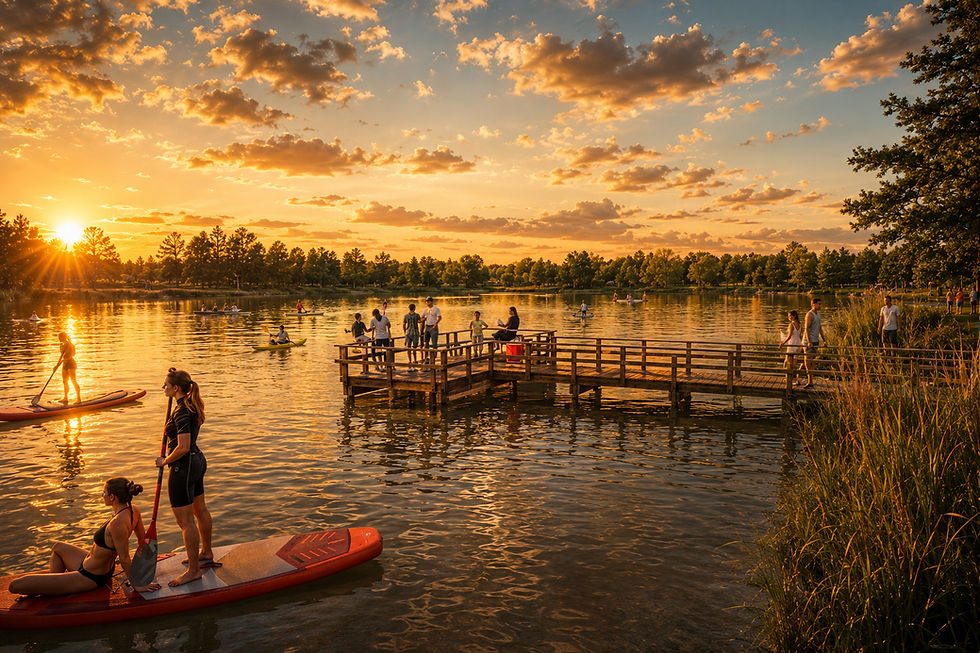
The result is a place that performs ecologically while feeling restorative and memorable. It holds water, but it also holds life. It supports infrastructure needs, but it also supports birds, pollinators, soil systems, shade, movement, and human wellbeing.
This is the future of community landscape: not ornamental green space, but living infrastructure that connects environmental performance with everyday experience. When ecology is visible, functional, and deeply integrated, sustainability becomes something people can feel, not just something a project claims.
3. The Mobility Layer: Connected Networks That Turn Movement Into Access
Future communities cannot rely on a single mode of movement. For decades, development patterns have prioritized the car as the default, shaping places around parking fields, wide drives, and disconnected destinations. But as communities evolve, mobility must become more layered, flexible, and human-centered. The question is no longer simply, “Can people walk here?” It is, “How many meaningful ways can people access and experience this place?”
The Mobility Layer connects homes, retail, trails, parks, workplaces, civic spaces, and natural systems through a network of choices: shaded sidewalks, bike paths, trail connections, light rail, shared vehicles, rideshare zones, slow streets, and micro-mobility infrastructure. Each mode expands access and each connection reduces friction. Together, they create a community where movement feels intuitive, comfortable, and integrated into daily life.
This layer also creates opportunity beyond transportation. When people move through a place at a slower, more intentional pace, they notice more. They see neighbors, discover local businesses, pause at a courtyard, take a trail to dinner, or stop under a tree. Physical connection becomes social connection. A trail is no longer just circulation; it becomes a place where daily rhythms overlap. A light rail stop is not just infrastructure; it becomes an invitation to reduce parking, increase density, and design more active public spaces around arrival. A shared mobility program is not just convenience; it becomes a way to support a lifestyle with more choice and less dependence on ownership.
In Houston’s East End, The Plant demonstrates how proximity to light rail and bike corridors can support a more connected development model. Located along Harrisburg Boulevard, the project benefits from access to transit and active transportation networks, allowing the public realm to prioritize people, small businesses, patios, storefronts, and streetscape experience rather than defaulting to car-first design. In some urban contexts, proximity to transit can also support reduced parking requirements, freeing valuable land for green space, retail activation, and more human-scale development.

At Indigo, mobility is approached as part of a broader lifestyle system. Walkable streets, trails, agricultural amenities, and shared community resources work together to expand how residents move and connect. Even ideas like a community-accessible Rivian reflect a shift from private car dependency toward shared access and flexible mobility. These systems do more than move people efficiently. They support a culture of interaction, reduce barriers to access, and create more reasons for residents to engage with their surroundings.
For developers and municipalities, mobility is not just circulation planning. It is a value strategy. Better connections increase foot traffic, support local retail, reduce land consumed by parking, improve health outcomes, and make neighborhoods more resilient to changing transportation habits. When designed intentionally, mobility becomes the connective tissue of a community, linking people to places, places to commerce, and daily movement to moments of belonging.
Future communities will not be defined by how quickly people can pass through them, but by how meaningfully people can move within them.
4. The Social Layer: Everyday Places That Turn Proximity Into Belonging
The most meaningful communities are not built around a single destination. They are built through the everyday moments that happen between home, work, food, play, and nature. While traditional amenity centers can still play an important role, future communities have an opportunity to create something more integrated: a network of places that support daily life and make connection feel natural.
The Social Layer asks how a community invites people to linger, gather, and participate. At Indigo Commons, the public realm and local businesses become the amenity. Retail, food, farming, trails, and open space work together to create a community heart that feels active and authentic. A quick errand can become a conversation. A meal can become an evening outside. A local business can become a familiar ritual.
At Two Step Farm in Montgomery, the social anchor takes a different form: a dance hall, a place rooted in music, culture, and shared experience. In other communities, that anchor might be a brewery, restaurant, café, coworking space, farmstand, or neighborhood market. The most successful social spaces are not one-size-fits-all; they are rooted in the identity and rhythms of the people they serve.

Beyond commercial anchors, smaller residential spaces can be just as powerful. At Indigo, mews are woven directly into the neighborhood fabric. By removing every other street, homes can front onto shared green spaces, parks, and trail connections rather than only streets and driveways. This simple planning move changes the social pattern of the neighborhood. Children have places to play, neighbors see each other more often, and daily walks become opportunities for connection.
This is the power of the Social Layer: it turns planned space into shared life. When designed with intention, communities do not need to force interaction. They create the conditions for it, through comfort, visibility, access, programming, and places worth returning to.
Future communities will not be defined by how many gathering spaces they include, but by how seamlessly those spaces support the rituals, relationships, and everyday experiences that make people feel at home.
5. The Stewardship Layer: The Systems That Help Places Grow Stronger Over Time
Stewardship is often associated with caring for land, landscapes, and ecology. While that remains essential, its role in future communities is much broader. Stewardship is the long-term framework that allows a place to stay healthy, relevant, and meaningful as it evolves. It is the layer that protects the original vision while giving the community room to grow.
Each of the previous layers depends on stewardship. Living systems need ongoing care so trees mature, soils improve, and habitats strengthen. Mobility networks need refinement as patterns of movement change. Social spaces need programming, maintenance, and partnerships to remain active. Cultural identity needs organizations, traditions, and community leadership to carry it forward. Without stewardship, even strong design ideas can lose momentum.
The Stewardship Layer asks: who will care for this place, activate it, adapt it, and help it evolve? This may include HOAs, property owners’ associations, conservancies, municipal partners, landscape maintenance teams, local businesses, resident committees, nonprofit partners, or dedicated programming organizations. The specific structure may vary, but the goal is the same: create systems that support the place long after design and construction are complete.

When stewardship is considered early, it shapes better decisions. Planting strategies can be designed for long-term health rather than short-term appearance. Flexible greens can be planned with calendars, power access, storage, shade, and operations in mind. Trails and public spaces can be maintained as daily infrastructure, not occasional amenities. Community organizations can be empowered to host events, support local businesses, manage shared resources, and create traditions that deepen belonging.
This is where resilience becomes cultural, not just environmental. A resilient place is not only one that withstands heat, storms, or changing markets. It is one that continues to generate meaning. It learns from the people who use it. It adapts to new needs. It gives residents, tenants, and visitors reasons to return and participate.
For developers and municipalities, stewardship protects long-term value. It helps maintain brand identity, supports tenant success, strengthens community trust, and ensures that public realm investments continue to perform. For end users, stewardship is felt in small but powerful ways: shaded paths that improve each year, events that become traditions, landscapes that feel cared for, and gathering spaces that continue to reflect the people who use them.
Future communities will not be finished on opening day. They will be cultivated through the systems, partnerships, and care that allow them to become more resilient, more authentic, and more beloved over time.
Conclusion: Designing Communities That Feel Alive
The difference between a community that feels alive and one that feels like a checklist is rarely the number of amenities. It is the way those amenities are connected, layered, and cared for over time. A park, trail, lake, clubhouse, farm, café, or green space may each offer value on its own, but their greatest impact comes when they work together as part of a larger experience system.
Future communities will be shaped by this kind of integration. Ecology will do more than beautify; it will regenerate. Mobility will do more than move people; it will create access and social connection. Gathering spaces will do more than host activity; they will support the everyday rituals that build belonging. Identity will do more than brand a place; it will root culture in context. Stewardship will do more than maintain what is built; it will help communities grow stronger, more resilient, and more meaningful over time.
For developers, municipalities, and design teams, this shift is both a challenge and an opportunity. It asks us to think beyond isolated deliverables and toward the relationships between systems, spaces, and people. When we do, communities become more adaptable, more memorable, and more valuable, not only because they perform better, but because they feel better.
At CultivateLAND, this is the work we are most interested in: helping transform amenities into experiences, sites into systems, and communities into places where people feel connected, proud, and at home.
The question is no longer simply, what amenities should we add? The better question is: what kind of community are we cultivating?


Comments