

00
FIELD
NOTES
A Journal of Land in Practice

01
Where learning lives
Field Notes is our ongoing journal of land in practice.
It began as a way to document the in-between moments of landscape architecture. The sketches stained by rain. The soil blends tested before specification. The conversations on job sites before lines are drawn clean. But over time, it has become something more.
Field Notes is how we stay curious.
Our work may be rooted in landscape architecture, but the land does not recognize disciplinary boundaries. It intersects with agriculture, ecology, construction, culture, hydrology, food systems, and community life. To design well, we must observe broadly. To build resilience, we must learn continuously.
Field Notes is the space where that learning lives.
It is not a portfolio of finished perfection. It is a working archive of attention. A record of experiments, failures, adjustments, and discoveries. A place where we document what the land teaches us and how other disciplines sharpen our own.

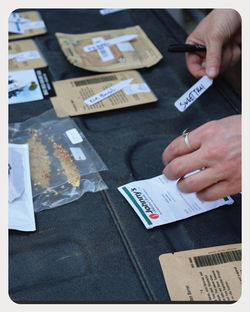
Figure 01: Tools of the Trade
 |  |  |  |  |  |
|---|---|---|---|---|---|
 |  |  |  |  |  |
 |  |  |  |  |  |
 |  |  |  |  |  |
 |
02
How we think, test & evolve
Each Field Note is organized around a theme central to our work:
Growing:
Making:
Observing:
Preserving:
Learning:
Growing acknowledges that our work is a partnership with time.
Making captures the craft and construction behind durable landscapes.
Observing documents the patterns that inform our design decisions.
Preserving honors what already exists and deserves continuity.
Learning reflects the humility required to work with living systems.
These are not categories of content. They are lenses through which we practice.
Field Notes is an invitation to see the landscape as we do.
Not as a finished object, but as a living document always in a state of becoming.
Over time, this archive will grow into something larger.
A collective record of land in practice.
A body of work that reflects how we think, how we test, and how we evolve.
Because if land is infrastructure, then understanding it requires presence. And presence requires documentation.

Figure 02: Garden Winterization
01
Subject:
Entry No:
Date:
Location:
Seeding: Cucumbers, Melons, Peppers, Summer Squash, Tomatoes
G-001
02.12.2026 [14:15]
Office Garden [29°48'40.60"N , 95°28'49.11"W]


Notes:
We began the season by sowing rare heirloom seeds in plug trays, varieties chosen for flavor, diversity, and genetic richness. Our mix of worm castings, coco fiber, soil, and vermiculite creates a balanced growing medium designed for both nutrition and drainage. With heating pads supporting germination, we’re creating the conditions for strong, early roots.
In design, we do the same: build the right foundation early, and the system thrives long after installation.
Observations:
-
Heating pads are a tiny microclimate, engineered for germination.
-
Just like a planting detail, treat the soil blend as a specification, not an afterthought.
-
Vermiculite holds water, coco fiber improves structure and water retention, worm castings provide nutrients.
-
Heirlooms = Biodiversity & Resilience
-
Monocultures are fragile, heirlooms preserve regional and cultural history.

Figure 01: Seed Trays w/ Vermiculite

Figure 02: 4" Transplants

Figure 03: Digging In The Dirt

Figure 04: Seed Tray Labeling

